(The news release “ARTICLE REGARDING SAFETY INFORMATION OF LECANEMAB PUBLISHED IN THE AMERICAN SCIENTIFIC JOURNAL SCIENCE” disclosed on November 29, 2022 has been corrected due to an error in the name of media in which the article was reported.)
First and foremost, we are incredibly grateful to all the patients and their families for their participation in Eisai’s lecanemab clinical trials. The well-being of the patients enrolled in our clinical studies is always Eisai’s top priority.
Eisai has established a rigorous safety monitoring process to ensure patient safety. This includes an independent data safety monitoring committee of external experts. All the available safety information indicates that lecanemab therapy is not associated with an increased risk of death overall.
Eisai promptly communicates important safety information to regulatory agencies, sites, investigators, and subjects through a variety of appropriate mechanisms including investigator communications, Independent Review Board (IRB) communications, and Informed Consent Form (ICF) revisions.
Eisai will present the full results, including consistent safety data, from the Phase 3 confirmatory Clarity AD clinical trial to the Alzheimer’s disease community at the Clinical Trials on Alzheimer’s disease on November 29, 2022.
Media Inquiries: Public Relations Department,
Eisai Co., Ltd.
+81-(0)3-3817-5120
Eisai Co., Ltd. (Headquarters: Tokyo, CEO: Haruo Naito, “Eisai”) announced today that the company will have a total of 34 poster presentations, including the latest data on its in-house discovered and developed anti-epileptic agent (AED) perampanel (product name: Fycompa®) at the 76th American Epilepsy Society Annual Meeting (AES 2022), to be held in Nashville, Tennessee and virtually from December 2-6, 2022.
Key data Presentations for perampanel include the:
Results from a post hoc analysis of the phase III clinical trial (FREEDOM/342), which evaluated long-term efficacy of perampanel monotherapy by seizure type in the open-label extension (52 weeks) for epilepsy patients with focal-onset seizures (FOS), ≥ 12 years of age without prior treatment history (poster number: 2.228)
Real-world pooled analyses of perampanel for pediatric patients (poster number: 1.310), adolescent patients (poster number: 1.313) and elderly patients (poster number: 1.312)
Results from a post hoc analysis of two phase III open-label extension (OLEx) studies, Study 307 and Study 335 OLEx, evaluating the long-term efficacy and safety of adjunctive perampanel in a subgroup of older adult patients aged ≥ 60 years (poster number: 1.291)
“With 34 poster presentations planned for this year’s AES Meeting, we look forward to furthering our understanding of the results that may impact overall care in epilepsy,” said Ivan Cheung, Senior Vice President Global Alzheimer’s Disease Officer President, Americas Region, Eisai Co., Ltd., “We remain focused on addressing the diverse needs of patients with epilepsy and their families.”
Perampanel is a first-in-class AED discovered by Eisai’s Tsukuba Research Laboratories. The agent is a highly selective, noncompetitive AMPA receptor antagonist that is postulated to reduce neuronal hyper-excitation associated with seizures by targeting glutamate activity at AMPA receptors on postsynaptic membranes. The agent is currently approved for partial-onset seizures (with or without secondarily generalized seizures) in over 70 countries including Japan, the United States, China and other countries in Europe and in Asia. The agent is currently approved as an adjunctive therapy for primary generalized tonic-clonic seizures in over 70 countries including Japan, the United States, and other countries in Europe and in Asia.
Eisai considers neurology, including epilepsy, a therapeutic area of focus. Eisai pursues its mission to provide “seizure freedom” to a greater number of patients with epilepsy. Eisai remains committed further to addressing the diverse needs of, and increasing the benefits provided to, patients with epilepsy and their families.
The following are studies that will be presented by Eisai at this year’s AES Annual Meeting.
Main poster presentations
Compound
Poster Number
Planned Date and Time
(Central Standard Time)
Efficacy and Safety of Perampanel as First or Only Adjunctive Therapy in Patients with Focal-Onset Seizures (FOS) or Generalized Tonic-Clonic Seizures (GTCS) in Studies 412, 501, 410, and 509
A Mirroring Clinical Practice Study of Perampanel in Adults and Adolescents (AMPA): Assessment of Impact of Perampanel on Seizure Control, Sleep, and Quality of Life (QoL)
Long-Term Efficacy of Perampanel Monotherapy in Patients with Newly Diagnosed/Currently Untreated Recurrent Focal-Onset Seizures: FREEDOM Study 342 Extension Phase Analysis by Seizure Type
ELEVATE Study 410: Analysis of Time to First Seizure with Perampanel as Monotherapy or First Adjunctive Therapy in Patients with Focal-Onset Seizures (FOS) or Generalized Tonic-Clonic Seizures (GTCS)
Media Inquiries: Public Relations Department,
Eisai Co., Ltd.
+81-(0)3-3817-5120
[Notes to Editors] 1.About perampanel (product name: Fycompa) Perampanel is a first-in-class anti-epileptic agent (AED) discovered and developed by Eisai. With epileptic seizures being mediated by the neurotransmitter glutamate, the agent is a highly selective, noncompetitive AMPA receptor antagonist that reduces neuronal hyperexcitation associated with seizures by targeting glutamate activity at AMPA receptors on postsynaptic membranes. Perampanel is currently approved in more than 70 countries and territories, including Japan, the United States, China, and other countries in Europe and in Asia as an adjunctive treatment for partial-onset seizures (with or without secondarily generalized seizures) in patients with epilepsy 12 years of age and older. In addition, perampanel has been approved in more than 70 countries, including the United States, Japan, in Europe and in Asia for treatment as an adjunctive therapy for primary generalized tonic-clonic seizures in patients with epilepsy 12 years of age and older. In Japan, the United States and China, perampanel is approved for monotherapy and adjunctive use in the treatment of partial-onset seizures (with or without secondarily generalized seizures) in patients with epilepsy 4 years of age and older. In Europe the approved age range is 4 years of age and older for the adjunctive treatment of partial-onset seizures (with or without secondarily generalized seizures) and 7 years of age and older for the treatment as an adjunctive therapy for primary generalized tonic-clonic seizure. perampanel is available in drug form to be taken once daily orally at bedtime. A tablet and fine granule formulation have been approved in Japan. An oral suspension formulation and tablet have been approved in the United States and Europe. A supplementary new drug application for an injection formulation has been submitted in Japan as a new route of administration. To date, perampanel has been used to treat more than 500,000 patients worldwide across all indications.
2.About Epilepsy Epilepsy is broadly categorized by seizure type, with partial-onset seizures accounting for approximately 60% of epilepsy cases and generalized seizures accounting for approximately 40%. In a partial-onset seizure, an abnormal electrical disturbance occurs in a limited area of the brain, and may subsequently spread throughout the brain, becoming a generalized seizure (known as a secondarily generalized seizure). In a generalized seizure, abnormal electrical disturbances occur throughout the brain, and can be followed by a loss of consciousness or physical symptoms manifested throughout the whole body.
Epilepsy affects approximately 3.4 million people in the United States, 1 million people in Japan, 6 million people in Europe, 9 million people in China, and approximately 60 million people worldwide. As approximately 30% of patients with epilepsy are unable to control their seizures with currently available AEDs,* this is a disease with significant unmet medical needs. Although onset occurs at any age, onset is most common in people aged 18 and younger and the elderly. As causes and clinical symptoms of pediatric epilepsy are not uniform, and prognoses can range from very positive cases to obstinate cases, special consideration for each patient is required of treatments.
Shimadzu Corporation (Shimadzu), Eisai Co., Ltd. (Eisai), Oita University, and Usuki City Medical Association hereby announce the commencement of a cohort study using Usuki City as a demonstration site. This joint study will attempt to develop Japan’s first diagnostic workflow for mild cognitive impairment (MCI) and Alzheimer’s disease (AD) that uses blood biomarkers. In accordance with “Guidelines for Proper Use of Cerebrospinal Fluid and Blood Biomarkers in Dementia”*1, this study aims to demonstrate the utility of blood biomarkers and improve the early diagnosis of Alzheimer’s disease within a coordinated system of medical care that encompasses primary care physicians and specialists who are members of dementia-related medical societies.
In cases of Alzheimer’s disease, which is said to account for more than 60 % of dementia cases, amyloid beta (Aβ, a protein thought to cause AD) starts aggregating in the brain around 20 years before AD onset. Positron emission tomography (amyloid PET) and cerebrospinal fluid (CSF) testing are used to estimate the degree of Aβ accumulation in the brain, but only a limited number of facilities are capable of performing these investigations and the high cost of testing and physical stress involved due to the invasiveness of these investigations also pose a challenge. The increased use of blood biomarkers is expected to reduce the burden on patients.
■ Study Schema
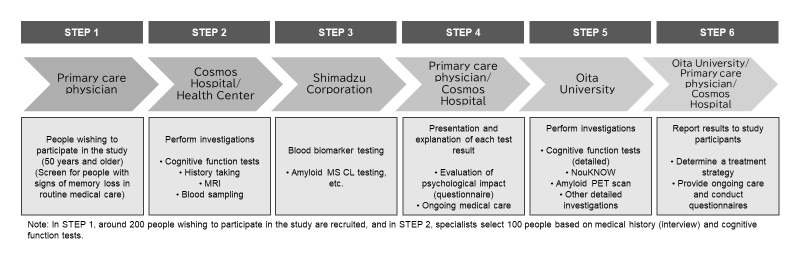
Usuki City Medical Association will recruit applicants (50 years and older) who wish to participate in the study. Primary care physicians affiliated with Usuki City Medical Association will perform simple cognitive function tests on applicants and select around 200 people with suspected MCI or mild dementia. Specialists affiliated with Usuki City Medical Association Cosmos Hospital (Cosmos Hospital) will then take an in-depth medical history and perform more detailed cognitive function tests before making a final selection of 100 subjects with MCI or mild dementia who are suspected of having Alzheimer’s disease. Shimadzu will be responsible for analyzing and evaluating blood biomarker data obtained using Shimadzu’s Amyloid MS CL system for measuring amyloid peptides in blood (Amyloid MS CL)*2. Primary care physicians affiliated with Usuki City Medical Association and specialists affiliated with Cosmos Hospital will present and explain test results to participants, evaluate the psychological impact of these results, and provide ongoing medical care as needed. At the Department of Neurology, Faculty of Medicine, Oita University, detailed cognitive function tests will be performed, a self-assessed measurement of brain health will be performed using the “NouKNOW”*3 tool developed by Eisai, Aβ accumulation will be checked by amyloid PET, and the utility of blood biomarkers will be verified. Eisai will use its expertise in dementia research to propose ideas and assist with study planning and provide advice on methods of analyzing and reviewing test results and psychological impact. All four parties will combine findings from evaluating the clinical performance of blood biomarkers and the psychological effects of disclosing test results to ascertain the acceptability of blood biomarkers under actual clinical conditions.
With this joint research, the four parties aim to establish a new diagnostic workflow for Alzheimer’s disease that is based on blood biomarkers and includes primary care physicians. Through this work, the four parties are committed to building an ecosystem that improves the early detection of Alzheimer’s disease and to developing social infrastructure that allows those concerned and their families to live in peace and security.
*1 Japanese Ministry of Health, Labour and Welfare Grants for Scientific Research, Study Group, March 31, 2021
*2 Amyloid MS CL is a product that measures amyloid peptides (the main component of amyloid plaques, which are a characteristic feature of Alzheimer’s disease) in the blood and provides biomarker data related to amyloid beta levels. In June 2021, Amyloid MS CL was the first product to measure amyloid peptides with a mass spectrometric technique to be approved for use as a medical device in Japan.
*3 “NouKNOW” (non-medical equipment) is a tool developed by Eisai for the self-assessment of brain health (brain performance). “NouKNOW” was developed based on an algorithm created by Cogstate Ltd. (Headquarters: Australia) for which Eisai holds the exclusive rights for development and commercialization worldwide. “NouKNOW” uses common playing cards displayed on a PC or similar device to test brain response time, attention, visual learning, and memory. “NouKNOW” are registered trademarks of Eisai.
Eisai Co., Ltd. (Headquarters: Toyoko, CEO: Haruo Naito, “Eisai”) will present the efficacy, safety and biomarker findings from the company’s Phase 3 confirmatory Clarity AD clinical trial for lecanemab (development code: BAN2401), an investigational anti-amyloid beta (Aβ) protofibril antibody for the potential treatment of mild cognitive impairment (MCI) due to Alzheimer’s disease (AD) and mild AD (collectively known as early AD) with confirmed presence of amyloid pathology in the brain, at the 15th Clinical Trials on Alzheimer’s Disease (CTAD) conference. At the meeting, which will be held in San Francisco, CA and virtually from November 29 to December 2, Eisai and esteemed faculty will present the full data in a scientific session on the first day of the meeting (November 29 at 4:50 p.m. PT). Additionally, other important research from the lecanemab clinical development program and Eisai’s AD pipeline, including the company’s investigational anti-microtubule binding region (MTBR) tau antibody (E2814), will be presented in four oral and ten poster presentations.
Topline results from Clarity AD were announced in late September and showed that lecanemab met the primary endpoint and all key secondary endpoints with highly statistically significant results, and the profile of Amyloid-Related Imaging Abnormalities (ARIA) incidence was within expectations.
Key Eisai Lecanemab CTAD Presentations
Clarity AD: Full results from the Phase 3 confirmatory Clarity AD clinical trial of lecanemab in patients with early AD will be presented in a scientific session on November 29 at 4:50 p.m. PT. Eisai will host a live webcast of presentations in the session and can be viewed live on the investors section of the Eisai Co., Ltd. website.
Aβ Protofibrils Binding Properties: Research studying the characterization of Aβ protofibrils and the unique binding properties and mechanisms of Aβ clearance of lecanemab (Poster #P029)
AHEAD 3-45 Study:
An evaluation of tau PET screening data from the Phase 3 AHEAD 3-45 study of lecanemab for associations with plasma p-tau217 and cognitive testing (Late Breaker Oral #LB1)
A study exploring increased accuracy of amyloid PET prediction in preclinical AD using plasma levels for Abeta42/40 and p-tau217 ratios from the Phase 3 screening data from the AHEAD 3-45 study (Late Breaker Oral #LB2)
“Based on the Clarity AD results, the investigational anti-amyloid beta protofibril antibody lecanemab has the potential to make a clinically meaningful difference for people living with the early stages of Alzheimer’s disease and their families by slowing cognitive and functional decline,” said Lynn Kramer, M.D., Chief Clinical Officer, Alzheimer’s Disease and Brain Health at Eisai Co., Ltd. “Eisai is excited to share the results of the company’s confirmatory Phase 3 Clarity AD clinical study at CTAD and present important data exploring lecanemab’s potential efficacy, safety and use in a variety of early AD patient sub-populations.”
Eisai aims to file for traditional approval in the U.S. and for marketing authorization applications in Japan and Europe by the end of Eisai’s FY2022, which ends March 31, 2023. In July 2022, the U.S. Food and Drug Administration (FDA) accepted Eisai’s Biologics License Application (BLA) for lecanemab under the accelerated approval pathway and granted it Priority Review. The Prescription Drug User Fee Act (PDUFA) action date is January 6, 2023. The FDA has agreed that the results of Clarity AD can serve as the confirmatory study to verify the clinical benefit of lecanemab. In an effort to secure traditional FDA approval for lecanemab as soon as possible, Eisai submitted the BLA through the FDA’s Accelerated Approval Pathway so that the agency could complete its review of all lecanemab data with the exception of the data from the confirmatory Clarity AD study. In March 2022, Eisai began submitting application data, with the exception of Clarity AD data, to Japan’s Pharmaceuticals and Medical Devices Agency (PMDA) under the prior assessment consultation system, with the aim of obtaining early approval for lecanemab so that people living with early AD may have access to the therapy as soon as possible.
CTAD 2022 Presentations Relating to Eisai’s Key Compounds, Research and Collaborations
Scientific Session: Clarity AD: A Phase 3 Placebo-Controlled, Double-Blind, Parallel-Group, 18-Month Study Evaluating Lecanemab in Early Alzheimer’s Disease Tues, Nov 29, 4:50 – 6:05 p.m. PT
Chairman: Takeshi Iwatsubo, University of Tokyo
Clarity AD: Clinical Trial Background and Study Design Overview
Michael Irizarry
Eisai Inc.
Lecanemab for the Treatment of Early Alzheimer’s Disease: Topline Efficacy Results from Clarity AD
Christopher van Dyck
Yale School of Medicine
Safety Profile of Lecanemab in Early Alzheimer’s Disease
Marwan Sabbagh
Barrow Neurological Institute
Imaging, Plasma and CSF Biomarkers Assessments from Clarity AD
Randall Bateman
Washington University
Context of Clarity AD Results
Sharon Cohen
Toronto Memory Program
Panel Discussion / Q&A
Oral Presentations
Asset in Development, Session, Time (Pacific Time)
Tau PET Associated with Plasma P-Tau217 and Cognitive Testing in Preclinical AD: Screening Data from the AHEAD Study A3 and A45 Trials
Presenter: K Johnson
Authors: K Johnson, et al
Plasma Levels of Abeta42/40 and P-Tau217 Ratios Increase Accuracy of Amyloid PET Prediction in Preclinical AD
Presenter: R Rissman
Authors: R Rissman, et al
Results of a Phase 2/3 Placebo-Controlled, Double-Blind, Parallel-Group, Randomized Study to Evaluate the Efficacy and Safety of 12 Week Treatment with the Phosphodiesterase 9 (PDE9) Inhibitor Irsenontrine (E2027) in Subjects with Dementia with Lewy Bodies
Presenter: M Irizarry
Authors: M Irizarry, et al
Poster Presentations
Asset in Development, Session, Time (Pacific Time)
Presentation Title, Authors
Lecanemab Session: Clinical Trials Methodology: #P012
Tues, Nov 29, 4:00 p.m. –
Wed, Nov 30, 6:00 p.m.
Development and Feasibility of a Data-Driven Approach to Preclinical Alzheimer’s Disease Clinical Trial Recruitment through Centralized Pre-Screening Data Collection
Authors: D Kirn, et al
Lecanemab Session: New Therapies and Clinical Trials: #P029
Tues, Nov 29, 4:00 p.m. –
Wed, Nov 30, 6:00 p.m.
Characterization of Amyloid-Beta Protofibrils in Alzheimer’s Disease Brain and the Unique Binding Properties of Lecanemab
Authors: L Lannfelt, et al
E2027 Session: Clinical Trials Results: #P048
Tues, Nov 29, 4:00 p.m. –
Wed, Nov 30, 6:00 p.m.
The Effects of the Novel Phosphodiesterase 9 (PDE9) Inhibitor E2027 (irsenontrine) on CSF cGMP, Additional CSF and Plasma Biomarkers, and Clinical Outcomes in Amyloid Positive and Amyloid Negative Patients with Dementia with Lewy Bodies and Parkinson’s Disease Dementia
Authors: P Sachdev, et al
General AD Session: Clinical Trials Results: #P037
Tues, Nov 29, 4:00 p.m. –
Wed, Nov 30, 6:00 p.m.
Planning the Next Generation of Alzheimer’s Disease Clinical Trials Using Diverse Patient-Level Database from the Critical Path for Alzheimer’s Disease (CPAD) Consortium
Authors: S Sivakumaran, et al
General AD Session: Clinical Trials Results: #P038
Tues, Nov 29, 4:00 p.m. –
Wed, Nov 30, 6:00 p.m.
Critical Path for Alzheimer’s Disease (CPAD) Consortium: Accelerating and De-Risking Therapeutic Development in AD by Building Regulatory Decision-Making Tools
Authors: S Sivakumaran, et al
General AD Session: Clinical Trials Biomarkers Including Plasma: #LP66
Thu, Dec 1, 8:00 a.m. – 6:00 p.m.
Baseline Plasma pTau181 Improves Prediction of Cognitive Decline in Amyloid Positive Subjects with Mild Cognitive Impairment
Authors: V Devanarayan, et al
General AD Session: Epidemiology and Clinical Trials: #P176
Fri, Dec 2, 8:00 a.m. – 5:00 p.m.
Identification of Medical Conditions as Risk Factors for Mild Cognitive Impairment: A US Claims Database Study
Authors: G Li, et al
General AD Session: Epidemiology and Clinical Trials: #P184
Fri, Dec 2, 8:00 a.m. – 5:00 p.m.
Prevalence Estimations for the Alzheimer’s Disease Continuum in the US Health and Retirement Study
Authors: A Abbas Tahami Monfared, et al
General AD Session: Cognitive and Functional Endpoints:
#P139 (Virtual Only)
Thu, Dec 1, 8:00 a.m. – 6:00 p.m.
Dementia Conversion Rate Differences Between Patients with High- and Low-Risk Amnestic Mild Cognitive Impairment in the Real-World: A Prospective, Multicenter, Observational Study
Authors: H Jang, et al
Sysmex Poster Presentation
Asset in Development, Session, Time (Pacific Time)
Presentation Title, Authors
General AD Session: Clinical Trials Biomarkers Including Plasma: #LP84A
Thu, Dec 1, 8:00 a.m. – 6:00 p.m.
Three Group Classification of Participants Based on Fully Automated Plasma β-amyloid Measurements to Achieve High Positive and Negative Predictive Values
Authors: K Yamashita, et al
Eisai serves as the lead of lecanemab development and regulatory submissions globally, with both Eisai and Biogen co-commercializing and co-promoting the product and Eisai having final decision-making authority.
This release discusses investigational uses of agents in development and is not intended to convey conclusions about efficacy or safety. There is no guarantee that such investigational agents will successfully complete clinical development or gain health authority approval.
Media Inquiries:
Eisai Co., Ltd.
Eisai Inc. (U.S.)
Eisai Europe, Ltd. (Europe, Australia, New Zealand and Russia)
A Study to Confirm Safety and Efficacy of Lecanemab in Participants with Early AD (Clarity AD)
Study population
1,795 participants of mild cognitive impairment (MCI) due to AD and mild AD (collectively known as early AD) with confirmed presence of amyloid pathology in the brain in the global study, and an additional 111 subjects ongoing in China
Treatment administered
10 mg/kg bi-weekly of lecanemab
Duration of treatment
18 months
Study locations
Japan, the U.S., Europe and China
Primary endpoint
Change from baseline in the Clinical Dementia Rating-Sum of Boxes (CDR-SB*) at 18 months
Key secondary endpoints
Change From Baseline in Amyloid Positron Emission Tomography (PET) using Centiloids, AD Assessment Scale – Cognitive Subscale 14 (ADAS-cog14**), AD Composite Score (ADCOMS***) and AD Cooperative Study-Activities of Daily Living Scale for Mild Cognitive Impairment (ADCS MCI-ADL****) at 18 months
*CDR-SB is a numeric scale used to quantify the various severity of symptoms of dementia. Based on interviews of people living with AD and family/caregivers, qualified healthcare professionals assess cognitive and functional performance in six areas: memory, orientation, judgment and problem solving, community affairs, home and hobbies, and personal care. The total score of the six areas is the score of CDR-SB, and CDR-SB is also used as an appropriate item for evaluating the effectiveness of therapeutic drugs targeting the early stages of AD.
**ADAS-cog is the most common cognitive assessment instrument used in AD clinical trials all over the world. ADAS-cog14 consists of 14 competencies: word recall, commands, constructional praxis, object and finger naming, ideational praxis, orientation, word recognition, remembering word recognition instructions, comprehension of spoken language, word finding difficulty, spoken language ability, delayed word recall, number cancellation and maze task. ADAS-cog has been used in clinical trials for earlier stages of AD including MCI.
***Developed by Eisai, ADCOMS combines items from the ADAS-cog scale for assessing cognitive functions, MMSE and the CDR scale for evaluating the severity of dementia to enable highly sensitive detection of changes in clinical functions of early AD symptoms and changes in memory.
****ADCS MCI-ADL assesses the competence of patients with MCI in activities of daily living (ADLs), based on 24 questions to the patient’s partner about actual recent activities of daily living.
2. About Lecanemab (Development code: BAN2401) Lecanemab is an investigational humanized monoclonal antibody for AD that is the result of a strategic research alliance between Eisai and BioArctic. Lecanemab selectively binds to neutralize and eliminate soluble, toxic amyloid-beta (Aβ) aggregates (protofibrils) that are thought to contribute to the neurodegenerative process in AD. As such, lecanemab may have the potential to have an effect on disease pathology and to slow down the progression of the disease. Currently, lecanemab is being developed as the only anti-Aβ antibody that can be used for the treatment of early AD without the need for titration.
In the global Phase 3 confirmatory Clarity AD study, lecanemab treatment met the primary endpoint and reduced clinical decline on the global cognitive and functional scale, CDR-SB, compared with placebo at 18 months by 27%, which represents a treatment difference in the score change of -0.45 (p=0.00005) in the analysis of Intent-to-treat (ITT) population. Starting as early as six months, across all time points, the treatment showed highly statistically significant changes in CDR-SB from baseline compared to placebo (all p-values are less than 0.01). All key secondary endpoints were also met with highly statistically significant results compared with placebo (p<0.01). Key secondary endpoints were the change from baseline at 18 months compared with placebo of treatment in amyloid levels in the brain measured by amyloid positron emission tomography (PET), the AD Assessment Scale-cognitive subscale14 (ADAS-cog14), AD Composite Score (ADCOMS) and the AD Cooperative Study-Activities of Daily Living Scale for Mild Cognitive Impairment (ADCS MCI-ADL). The incidence of amyloid-related imaging abnormalities-edema/effusion (ARIA-E), an adverse event associated with anti-amyloid antibodies, was 12.5% in the lecanemab group and 1.7% in the placebo group. The incidence of symptomatic ARIA-E was 2.8% in the lecanemab group and 0.0% in the placebo group. The ARIA-H (ARIA cerebral microhemorrhages, cerebral macrohemorrhages, and superficial siderosis) rate was 17.0% in the lecanemab group and 8.7% in the placebo group. The incidence of symptomatic ARIA-H was 0.7% in the lecanemab group and 0.2% in the placebo group. There was no imbalance in isolated ARIA-H (i.e., ARIA-H in patients who did not also experience ARIA-E) between lecanemab (8.8%) and placebo (7.6%). The total incidence of ARIA (ARIA-E and/or ARIA-H) was 21.3% in the lecanemab group and 9.3% in the placebo group. Overall, lecanemab’s ARIA incidence profile was within expectations.
Since July 2020, the Phase 3 clinical study (AHEAD 3-45) for individuals with preclinical AD, meaning they are clinically normal and have intermediate or elevated levels of amyloid in their brains, is ongoing. AHEAD 3-45 is conducted as a public-private partnership between the Alzheimer’s Clinical Trial Consortium that provides the infrastructure for academic clinical trials in AD and related dementias in the U.S, funded by the National Institute on Aging, part of the National Institutes of Health, Eisai and Biogen.
Since January 2022, the Tau NexGen clinical study for Dominantly Inherited AD (DIAD), that is conducted by Dominantly Inherited Alzheimer Network Trials Unit (DIAN-TU), led by Washington University School of Medicine in St. Louis, is ongoing and includes lecanemab as the backbone anti-amyloid therapy in combination with E2814 MTBR-tau antibody or placebo.
Furthermore, Eisai has initiated a lecanemab subcutaneous dosing Phase 1 study.
3. About E2814 An investigational anti-microtubule binding region (MTBR) tau antibody, E2814, is being developed as a disease-modifying agent for tauopathies including sporadic AD. Phase I clinical studies are underway. E2814 was discovered as part of the research collaboration between Eisai and University College London. E2814 is designed to prevent the spreading of tau seeds within the brains of affected individuals. In addition, a Phase II/III Tau NexGen study for the treatment of dominantly inherited Alzheimer’s disease (DIAD), conducted by the Dominantly Inherited Alzheimer Network Trials Unit (DIAN-TU) led by Washington University School of Medicine in St. Louis (St. Louis, MO, USA), is underway.
4. About the Collaboration between Eisai and Biogen for AD Eisai and Biogen have been collaborating on the joint development and commercialization of AD treatments since 2014. Eisai serves as the lead of lecanemab development and regulatory submissions globally, with both companies co-commercializing and co-promoting the product and Eisai having final decision-making authority.
5. About the Collaboration between Eisai and BioArctic for AD Since 2005, Eisai and BioArctic have had a long-term collaboration regarding the development and commercialization of AD treatments. Eisai obtained the global rights to study, develop, manufacture and market lecanemab for the treatment of AD pursuant to an agreement with BioArctic in December 2007. The development and commercialization agreement on the antibody lecanemab back-up was signed in May 2015.
6. About the Collaboration between Eisai and Sysmex Eisai and Sysmex entered into a comprehensive non-exclusive collaboration agreement aimed at the creation of new diagnostics in the field of dementia in February 2016. Leveraging each other’s technologies and knowledge, the two companies aim to discover next-generation diagnostics that will enable early diagnosis, selection of treatment options and regular monitoring of the effects of treatment for dementia.
Values are an integral part of our foundation. With every decision, we ensure that we follow:
Integrity
Integrity is the living up to legal, moral and ethical principles in the conduct of HI-Eisai Pharmaceutical Inc. business. It means that each employee embodies the value of integrity, and therefore represents the company in honesty and rectitude in all the ways they do their work.
It is expected that each employee would make decisions guided by good judgement, not just for one‘s self, but for HI-Eisai as the company. An employee who acts with integrity ensures that he has understanding of the principles by which the company operates, and in situations where he lacks clarity, will actively seek guidance.
Respect
The company is committed to ensure that it maintains a safe, inclusive, and healthy working environment that promotes productivity among employees. All employees are expected to show respect to fellow employees, customers, and patients, regardless of differences in gender, culture, backgrounds, and beliefs. Leaders in the organization are likewise expected to promote inclusivity with their teams, and shall not tolerate any discriminatory and offensive actions.
Accountability
Accountability at work means assuming responsibility for the business outcome and how that is achieved. It means that every employee, in whichever position, are equally responsible for the decisions and actions they make for the company. It is likewise, the responsibility of each employee to report, any knowledge of misconduct or potential violation to the company‘s rules and regulations.
Patient-Centric
At the heart of the company‘s operation are the patients. This means that every decision to be made, considers the potential impact and benefit to the patients. As such, the company commits itself in ensuring that business objectives align with its principle of human health care or hhc. The programs created and implemented are based on how well they could contribute to improving patients‘ lives.
For field-based employees, being patient-centric means that the focus of engagements with customers are on understanding patient needs as well as providing these stakeholders with comprehensive information on how HI-Eisai‘s products can support their patients goals.
For each employee, being patient-centric means taking on their responsibilities with care and consideration on how it impacts the patients experience, be it by making relevant information readily available for the doctors; or by ensuring access and availability to the medicines we offer.
Excellence
As a patient-centric company, we define Excellence by the outstanding quality of our work to improve patients‘ lives. Each employee is expected to consistently demonstrate work ethics that align to our values, policies, and our desire to provide above standard service. The company is committed in ensuring that all actions are in compliance with legal requirements.
Being excellent means that every employee passionately strives to be better and participates in the company‘s initiatives to develop their members in terms of knowledge, skills, and behavior, which will support a continuously improving, responsible and performance-driven workforce.
Our Vision
To be a successful and sustainable business in the Philippines by driving innovation and providing solutions to address unmet healthcare needs fueled by high-performing employees who deliver meaningful value and experience to patients and their families.
Our Mission
We give first thought to patients and their families, and to increasing the benefits health care provides.